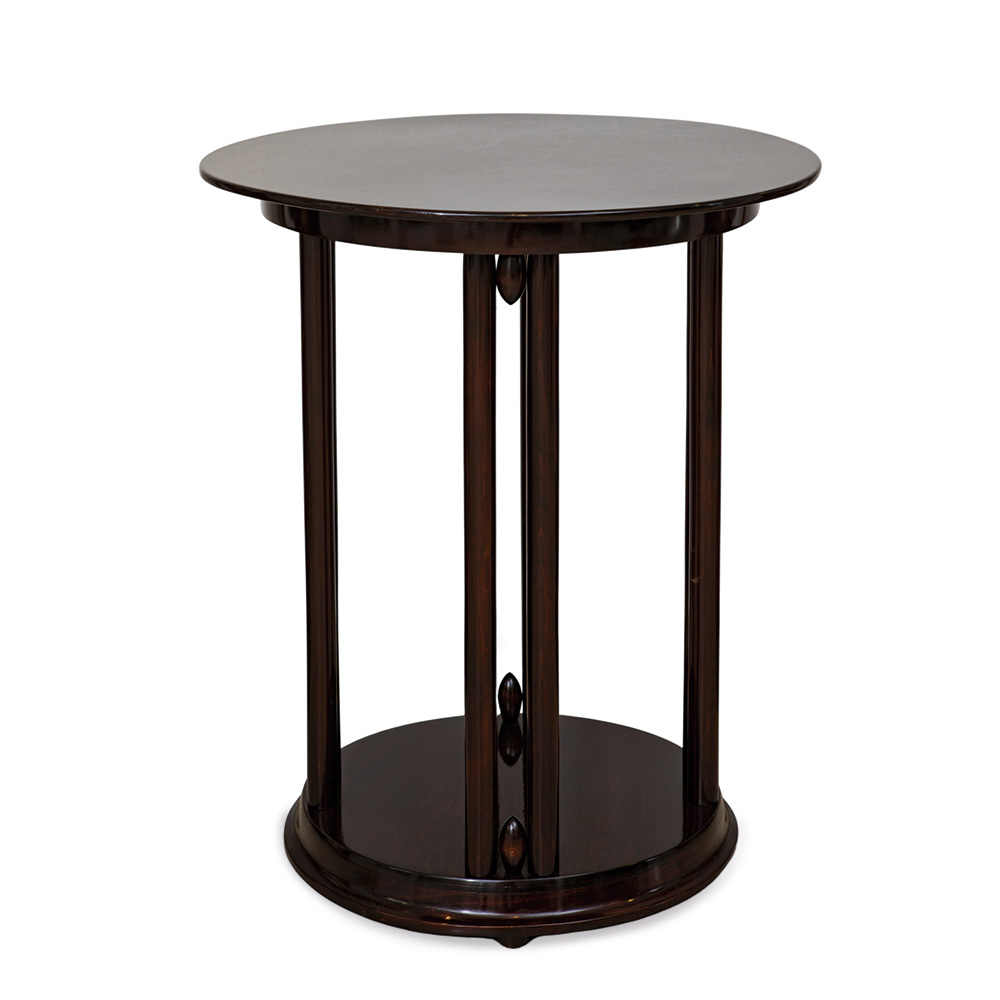
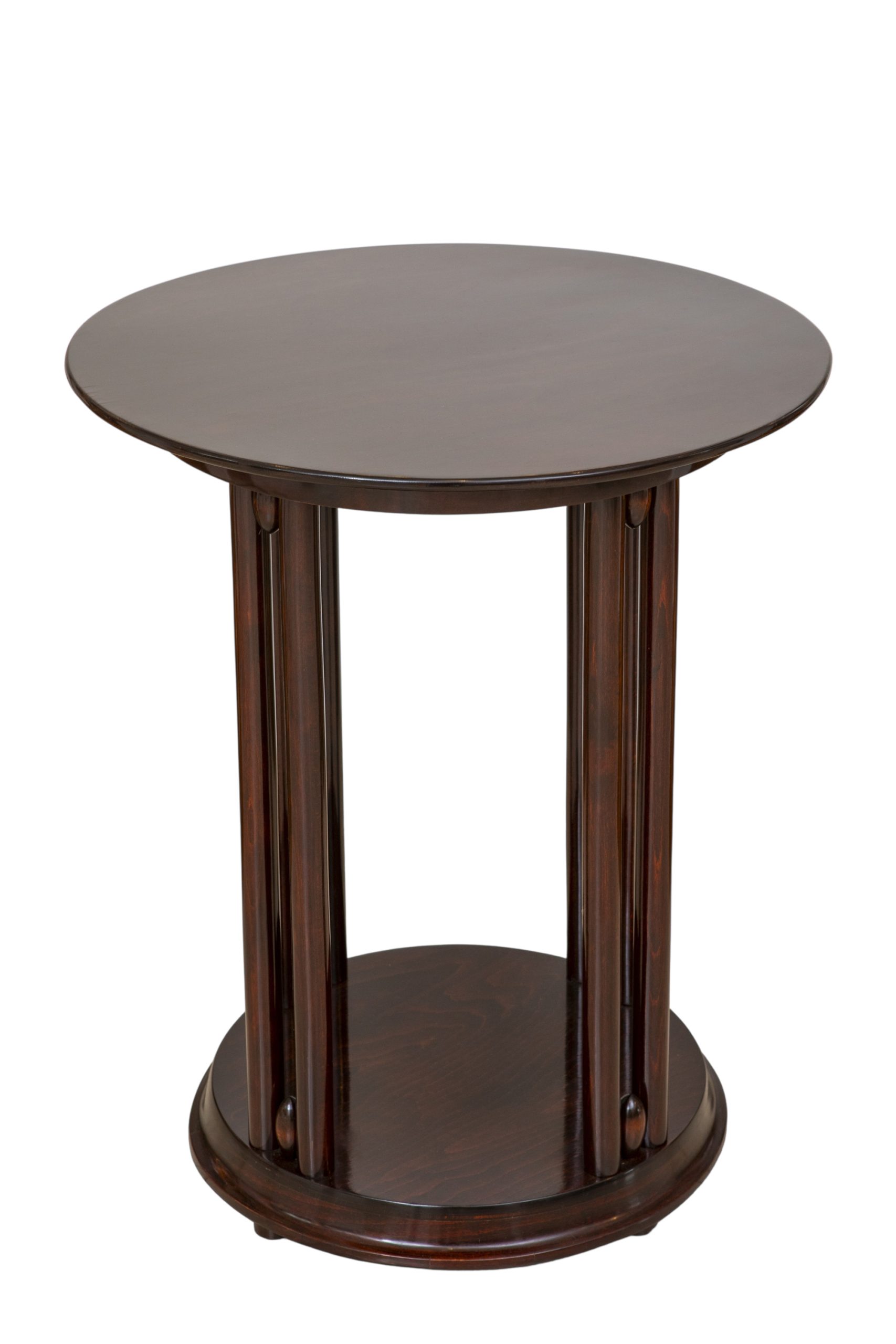
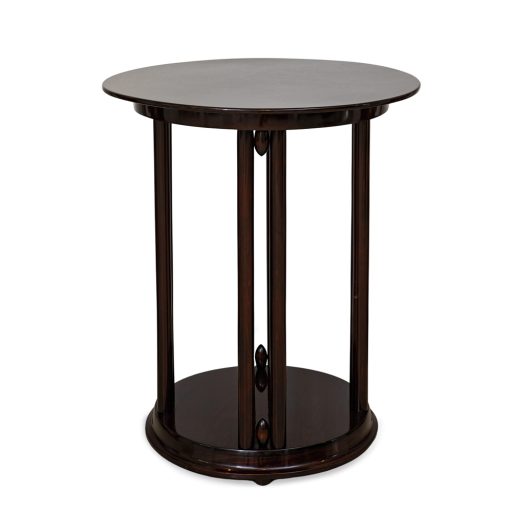
Side table, model “Fledermaus”, design Josef Hoffmann, execution Thonet, ca. 1912
marked “THONET” Bib.: comp. Giovanni Renzi, “Il mobile moderno”, Silvana Editoriale Spa, Milano 2008, p. 169 and p. 242-243
One of the most iconic furniture classics of the turn of the century was designed by Josef Hoffmann and his pupil Gustav Siegel for the furniture manufacturer J.& J. Kohn in 1905: The “728” series as part of the epochal “Fledermaus” furniture range.
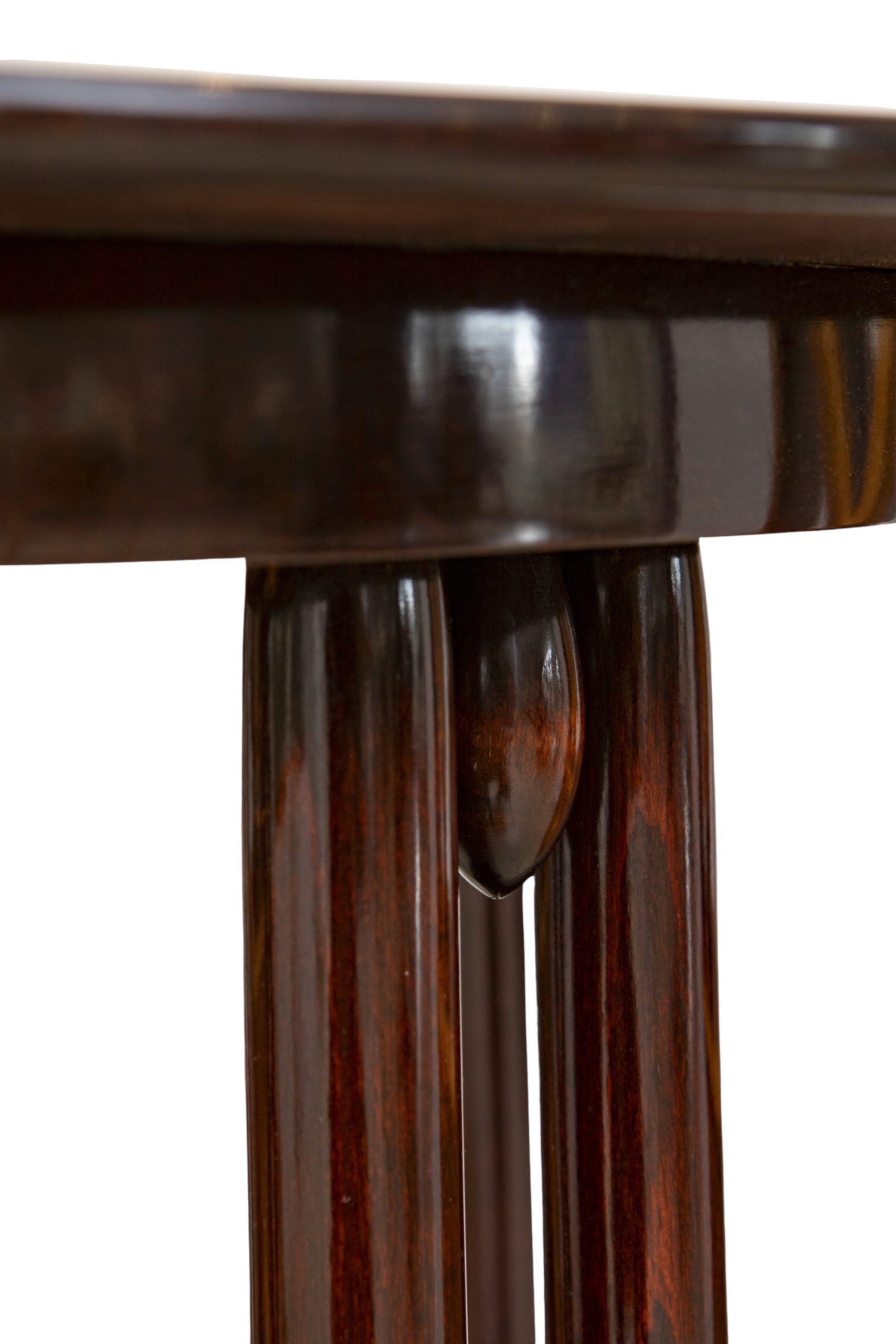
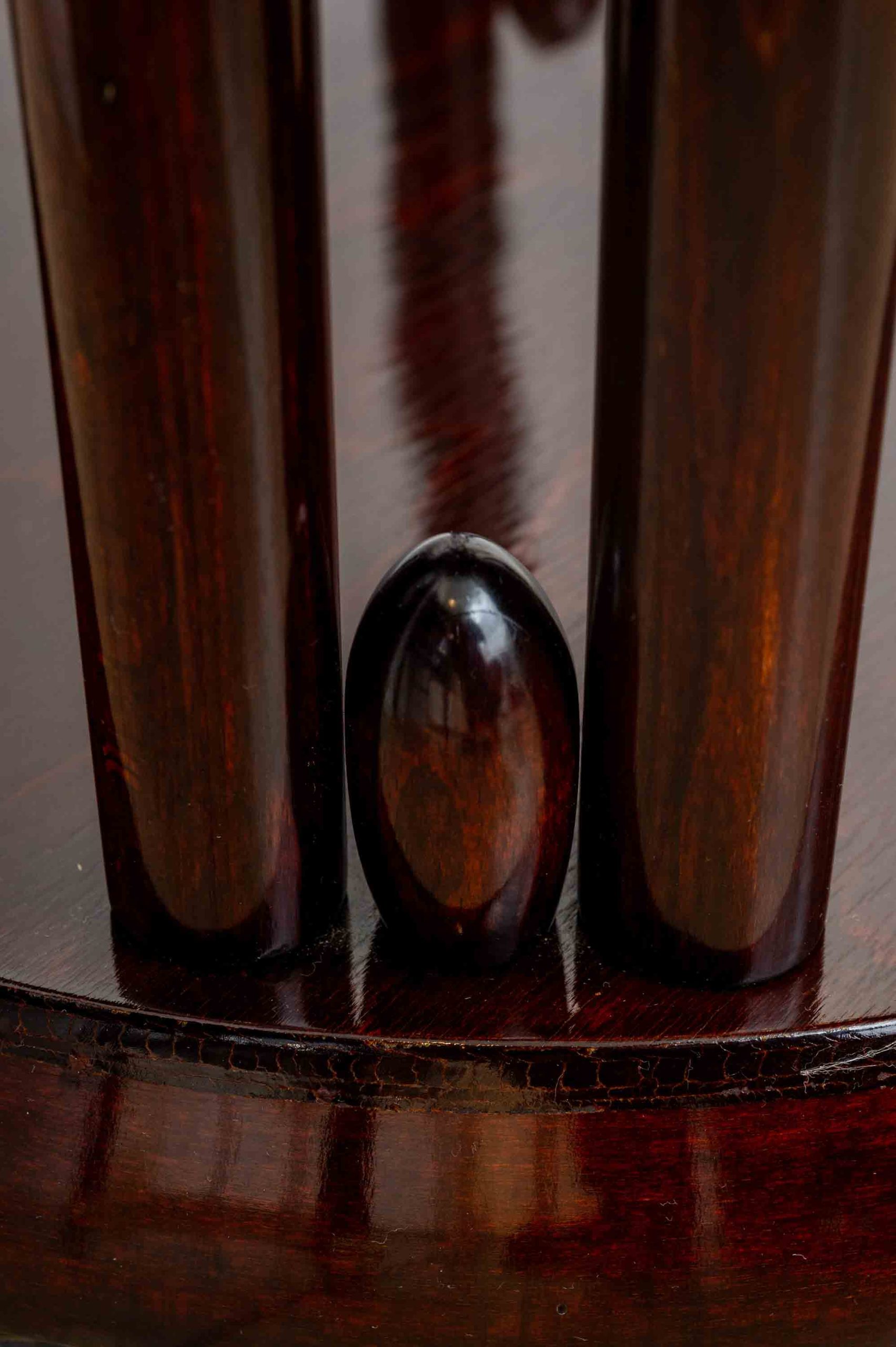
They lent this furniture the simple elegance of the time and placed it in sharp contrast to the heavy furniture of the late 19th century. Form follows function: the only decoration is the slender, round legs and the cones between them, which give the table its unmistakable silhouette. The fine polish emphasizes the natural grain of the wood to create an independent ornament.
Individual elements from the series were exhibited the following year at the international art exhibition in Milan
(1906). Although the official model name is not “Fledermaus”, it has become established both in specialist circles and in general usage. It stems from the fact that Josef Hoffmann used these models as part of the furnishings for the legendary “Cabaret Fledermaus” around 1907. The “Fledermaus” ensemble was so popular that architect Otto Schönthal chose it for the stylish furnishings of the exhibition café on the occasion of the famous art show in 1908.
The series was so successful that it remained an integral part of the production program even after the takeover of J. & J. Kohn by Mundus AG. Depending on production capacity, the same model was also produced by the furniture manufacturer Thonet, which later merged with Mundus AG.
Like no other company name, Thonet stands for Viennese Jugendstil bentwood furniture. The "Wiener Kaffeehausstuhl” (Viennese coffee house chair) from 1859 with the model number 14 has even made it into design history as a furniture icon. Michael Thonet (Boppard 1796 - 1871 Vienna), founder of the Gebrüder Thonet company, ensured its success by securing a patent in for the production of bentwood in 1842. Until the 1860s, he and his sons had a de facto monopoly on this innovative technique of bending wood under the effect of steam to make chairs and other furnishings. Bentwood technology had revolutionized European furniture design in the 19th century, as it enabled the development from handcrafted carpentry to industrial-serial production. Thonet managed this leap from manufacture to industrial serial production while maintaining high quality standards. Aesthetically at the cutting edge, Thonet commissioned renowned contemporary architects to design furniture, such as Otto Wagner, Josef Hoffmann, Marcel Kammerer and Otto Prutscher. Thonet's modern furnishings have been presented at many international exhibitions in Europe and overseas and have received many awards. The company owes its great commercial success to its dense distribution network with branches in all major European cities. In 1922, Thonet merged with the Mundus company, which had already acquired the company J. &. J. Kohn in 1914.
By sending the inquiry form, you accept the use of your data for this inquiry. Privacy Policy
Monday to Friday: 11:00 a.m. – 7:00 p.m.
Saturday: 11:00 a.m. – 4:00 p.m.
and by appointment
Phone: +43 1 513 32 69
E-Mail: info@floriankolhammer.com
Opening hours:
Monday to Friday: 11:00 a.m. – 7:00 p.m.
Saturday: 11:00 a.m. – 4:00 p.m.
and by appointment
Phone: +43 1 513 32 69
Email: info@floriankolhammer.com
Monday to Friday: 11:00 a.m. – 7:00 p.m.
Saturday: 11:00 a.m. – 4:00 p.m.